Implants
Aadva implant in private practice
Jahr 2015, Ausgabe 01, Seite 16 Autoren: Dr Jean Pierre Brun, Dr Philippe Leclercq, Prof. Joe Merheb, Dr Willem Frederik Simons, Prof. Bart Van Meerbeek, Prof. Marc Quirynen, Belgium
ePaper | PDF
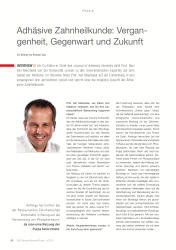
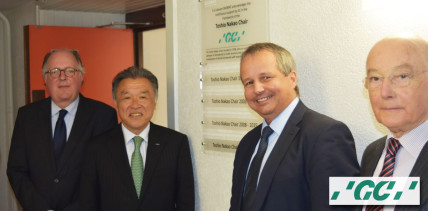
Bart VAN MEERBEEK obtained his DDS (dentist) in 1988 and his PhD in 1993 at KU Leuven (University of Leuven) in Belgium. He continued his research activity abroad for one year at the University of Texas Health Science Center at San Antonio, Texas, and later also during 3 months at the University of Missouri-Kansas City. In 1995, he became Assistant Professor (‘Docent’) at KU Leuven and since then teaches Dental Biomaterials Science. In 1998 and 2002, he was promoted respectively to Associate Professor (‘Hoofddocent’) and Professor (‘Hoogleraar’), and in 2005 to Full Professor (‘Gewoon Hoogleraar’). From August 2020, he serves as elected Chair of the KU Leuven Department of Oral Health Sciences (‘Departementsvoorzitter’; https://gbiomed.kuleuven.be/OralHealthSciences), as one of the 14 departments of the Biomedical Sciences Group of KU Leuven, for the next four years. He founded BIOMAT, the Biomaterials Research group (https://gbiomed.kuleuven.be/biomat), which focusses on diverse kinds of biomaterials with orofacial application, and encompasses fundamental material science and biological cell culture, micro-organism and animal research, as well as applied laboratory and clinical research. His primary research interest involves studies related to the broad field of Adhesive Dentistry, including fundamental as well as clinical research regarding dental adhesive technology in particular. Newer research lines deal with Dental Ceramics, Additive Manufacturing, Cariogenicity & Biocompatibility of Dental Materials, Bioactive Materials and Pulp-preservation Material Technology. His research work has been published in more than 500 peer-reviewed journals, having resulted in an h-index of 89Web of Science/129Google Scholar. He (co-)authored 8 papers that were listed in the top-100 most cited papers in the Journal of Dental Research, including the 5th highest cited paper (JDR 2019, 98:1425-1436), and 4 papers in the top-100 most cited dentistry overall papers, including the 22nd highest cited paper (Healthcare 2021, 9, 356). He has served as promoter/co-promoter of 14/4 PhDs (+ 5/2 ongoing). He has been honoured with several awards such as the 1996 triennial Robert Stock Award for best PhD dissertation in Biomedical Sciences, the 1997 Albert Joachim Award, the 1998 Biomedical Sciences Award of the Research Council of KU Leuven, the 2000 IADR Young Investigator Award, the 2003 Academy of Operative Dentistry Buonocore Memorial Lecturer, the 2008 CED-IADR (Continental European Division of IADR) Robert Frank Lecturer, the 2014 IADR/AADR William J. Gies Award for the best 2014 JDR paper in the Biomaterials & Bioengineering Research category, the 2015 IADR Wilmer Souder Award (IADR Distinguished Scientist award for Dental Materials), the 2020 EFCD (European Federation of Conservative Dentistry) Award of Excellence and the 2022 IADR Distinguished Service Award. Since 2003, he has been appointed as holder of the Toshio Nakao Chair for Adhesive Dentistry. He was President of the Pan-European Federation of IADR in 2006-2007 and served as Secretary of CED-IADR for 12 years (2009-2021). In September 2019 (Madrid), he was elected as President Elect of CED-IADR, and became CED-IADR president in September 2020 and organized the 2021 CED-IADR/NOF Oral Health congress in Brussels (September 16-18, 2021: https://ced-iadr2021.com/), and finally retired from the CED-IADR board as Past-President in September 2022. Since 2004, he is Editor-in-Chief of the Journal of Adhesive Dentistry.
Jahr 2020, Ausgabe 04, Seite 84 Autoren: Brandon Day im Gespräch mit Prof. Van Meerbeek
ePaper | PDF
Jahr 2014, Ausgabe dtch0714, Seite 10 Autoren: Redaktion
ePaper | PDF
Jahr 2014, Ausgabe 07_08, Seite 19 Autoren: Redaktion
ePaper | PDF
Jahr 2014, Ausgabe 04, Seite 11 Autoren: Redaktion
ePaper | PDF
Jahr 2014, Ausgabe 04, Seite 10 Autoren: Redaktion
ePaper | PDF
Jahr 2014, Ausgabe 01, Seite 24 Autoren: Redaktion
ePaper | PDF
Jahr 2014, Ausgabe 02, Seite 20 Autoren: Redaktion
ePaper | PDF
Jahr 2009, Ausgabe 11, Seite 28 Autoren: Redaktion
ePaper | PDF
Jahr 2005, Ausgabe 02, Seite 10 Autoren: Redaktion
ePaper | PDF
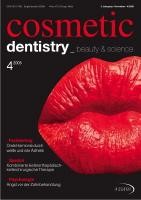
Jahr 2005, Ausgabe 04, Seite 62 Autoren: Redaktion
ePaper | PDF

Jahr 2004, Ausgabe 01, Seite 6 Autoren: Redaktion
ePaper | PDF
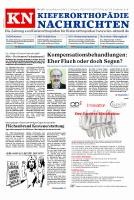
Jahr 2004, Ausgabe 01_02, Seite 19 Autoren: Redaktion
PDF
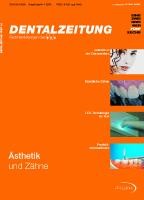
Jahr 2003, Ausgabe 04, Seite 66 Autoren: Manfred Kern, Arbeitsgemeinschaft für ...
ePaper | PDF
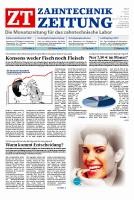
Jahr 2003, Ausgabe 08, Seite 17 Autoren: Redaktion
ePaper | PDF
Wir übermitteln Daten an Drittanbieter, die uns helfen, unser Webangebot zu verbessern und zu finanzieren. In diesem Zusammenhang werden auch Nutzungsprofile gebildet und angereichert, auch außerhalb des Europäischen Wirtschaftsraumes. Hierfür und um bestimmte Dienste zu nachfolgend aufgeführten Zwecken verwenden zu dürfen, benötigen wir Ihre Einwilligung.
Um Kartendaten in unserer Anwendung darzustellen, nutzen wir den Kartendienst Google Maps. Willigen Sie der Nutzung von Google Maps ein, werden ggf. personenbezogene Daten (Ihre IP-Adresse) von Google erhoben.
Einbinden von Google Maps erlaubenEinige unserer Videoinhalte (bspw. Livestream) werden über die Videoplattform Vimeo bereitgestellt.
Inhalte von Vimeo erlaubenEinige Beiträge binden Inhalte von Instagram ein. Wenn Sie zustimmen, wird eine Verbindung zu Meta/Instagram aufgebaut und es können personenbezogene Daten wie Ihre IP-Adresse übertragen werden.
Inhalte von Instagram erlaubenFür ein besseres Benutzererlebnis können unsere Werbeanzeigen personalisiert werden. Um dies zu ermöglichen, wird das erstellen von Cookies vorausgesetzt. Sollten Sie diesem Dienst nicht zustimmen, werden Werbeanzeigen zufällig ausgeliefert.
Personalisierte Werbung erlaubenUm sich bei unserer Anwendung Formulare zu verwenden werden Tokens gesetzt die es uns ermöglichen Spam zu verhindern. Sollten Sie dies ausstellen, ist es Ihnen nicht mehr möglich sich bei uns anzumelden oder zu registrieren.
Anmeldeformulare absenden ermöglichenBei der Gestaltung unserer Anwendung benutzen wir Schriftarten von Adobe, diese werden über ein CDN geladen. Sollte Sie diesem Dienst nicht zustimmen wird die Standard Schrift des Systems benutzt. Außerdem könnte es zu Fehlern im allgemeinen Anwendungsdesign kommen.
Inhalte von Adobe erlauben